Project overview
23FUN01 PhoQuS-T
Photonic and quantum sensors for practical integrated primary thermometry
This project aims to take advantage of the kelvin redefinition by developing novel small-scale optical based primary thermometry approaches for the dissemination of thermodynamic temperature to industries such as semiconductor, micro- and nanotechnology, aerospace and naval, green energy and quantum technologies.
The kelvin redefinition has stimulated new and disruptive approaches to delivering temperature traceability, namely practical primary thermometry at the point of measurement. Such approaches better meet user needs by providing lifetime on-demand reliable traceable temperatures. The most innovative ways to provide such traceability are the photonic/quantum-based approaches investigated in this project.
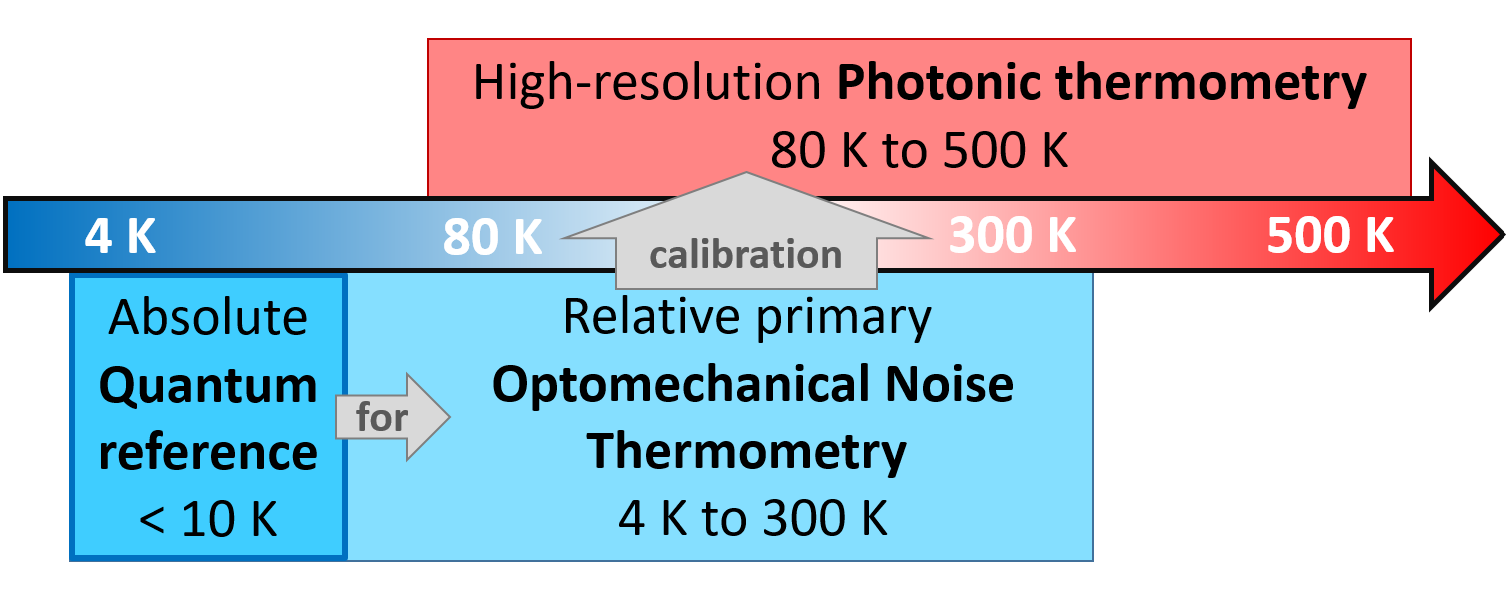
Based on the achievements of the 17FUN05 PhotOQuanT project, the 23FUN01 PhoQuS-T project will develop integrated optical practical primary thermometry from 4 K to 500 K to enable in-situ traceability in further practical applications. This will be reached through a combination of different technical approaches:
– With the optomecanical sensors (1D (nanobeam) or 2D (membrane)) the optical noise thermometry will be developed from 4 K to 300 K and the quantum thermometry will be tested below 10 K in order to provide a quantum reference for the optical noise thermometry (Objective 1).
– The operating temperature range will be extended from 80 K to 500 K with high-resolution photonic sensors based on passive and novel active photonic integrated circuits of micro- and nano-resonators. These photonic chip-based sensors need to be designed, manufactured and characterised and enhanced read-out techniques need to be developed and tested (Objective 2)- .
– For further practical applications, the integrated packaging for optomechanical and photonic sensors need to be developed as well as robust fibre to chip coupling over the temperature range from 4 K to 500 K needs to be developed by investigating different technologies for direct fibre coupling (laser welding, Finally, the developed sensors need to be metrologically evaluated by establishing the corresponding uncertainty budgets for optomechanical and photonic sensors in their respective operating ranges and their application in ion trap monitoring and quantum-based pressure standard will be demonstrated (Objective 4).
The advantages of the such sensors are: 1) a possibility of an in-situ traceability at point of measurement; 2) a photon-based approach which makes the sensor immune to electromagnetical perturbations; 3) a chipset technology which facilitates the direct integration of the sensor and allows for the micrometer-scale resolution measurements.
Multiple users would benefit from such an approach in Photonics and Quantum communities, and in industries using the embedded sensors: semiconductors, aerospace, cryogenics, hydrogen energy.